
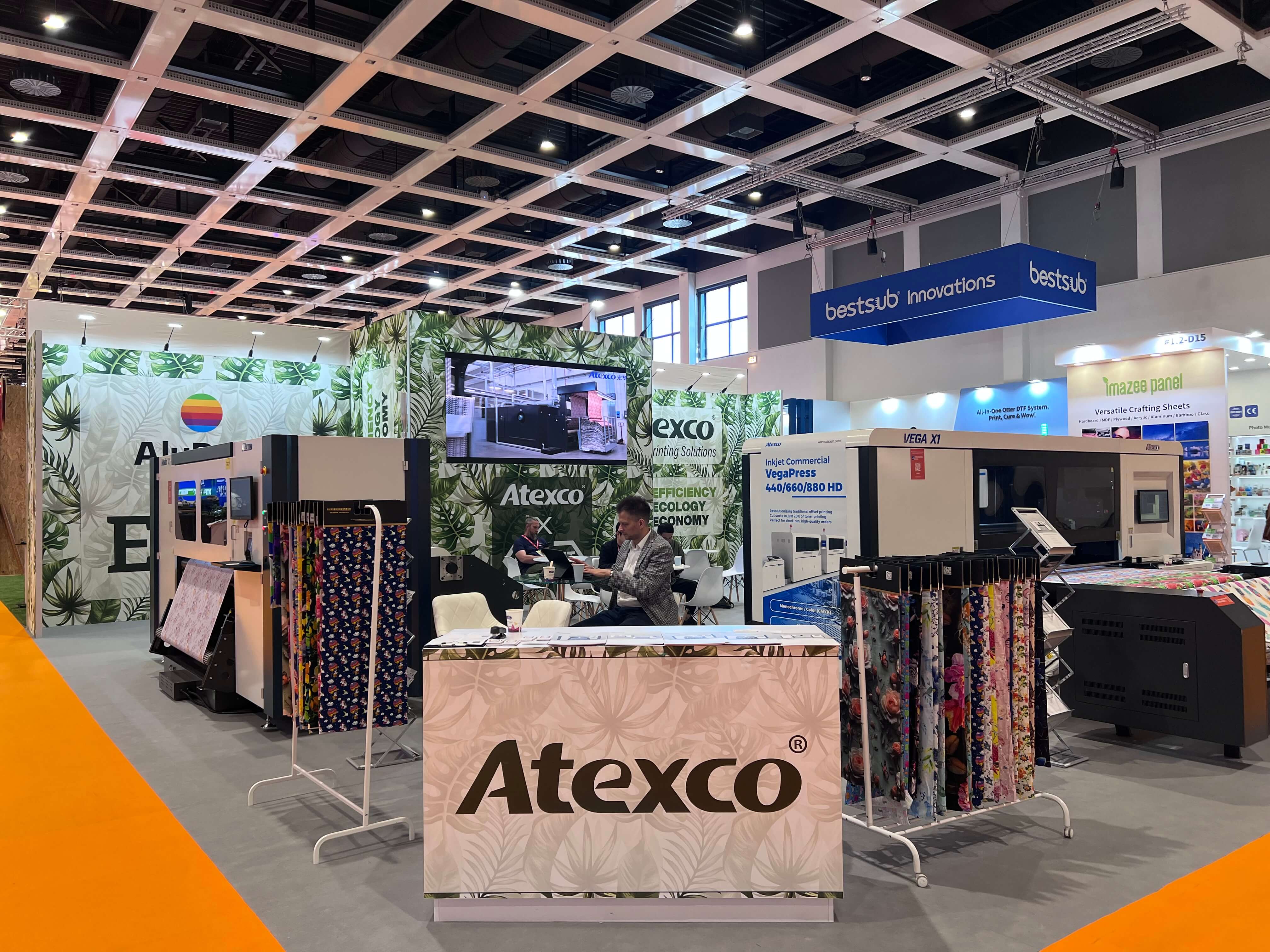
Digital textile printing includes five main families: Reactive, Acidic acid, Pigment, dispersive (direct) and sublimation. They differ in the mechanism of dyeing/fixation, the required production steps, durability, as well as energy and water consumption. The latter is crucial today — both cost-effectively and environmentally.
Technologies and inks used — at a glance
Reactive
Aqueous reactive inks form covalent bonds with cellulose (cotton, viscose, linen; also silk). Wet process after printing: evaporation, cold and hot rinsing (soaping) with repetitions, drying. Great saturation and resistance to washing, but large consumption of water and heat. Process recommendations and LCA studies comparing digital and rotary printing indicate a high water and energy load with this technology.
Acidic (Acid)
Acid inks for protein fibers (silk, wool) and polyamide/nylon. After printing: evaporation, cold rinse, warm wash, cold final rinse, drying. Very vivid colors (including neon), high resistance; still, however, the process “wet”.
Pigment (Pigment)
Thermally fixed/IR pigment, no washing after printing. One family of inks works on many fibers, great light resistance, today already high saturation. In modern variants, neon colors are also available. Importantly, there are commercial “single-step” systems that build preparation and fixation into a single run and eliminate pre- and post-treatment — a big operational and environmental change.
Dispersion — Disperse Direct
For polyester; dispersion dyes fixed at high temperature, followed by rinsing (cold/hot), sometimes reduction clearing for dark colours. High durability; energy consumption increases by high temperatures and wet processing.
Sublimation (DYE-sub)
Transfer from paper to polyester/PES coating at 180-205 °C; no washing after printing, practically no water used. The energy is mainly consumed by the calendar/press.
Energy and water — how are the technologies different?
Metrics and standards
Comparisons of “kWh/m²” are possible, but manufacturers rarely publish hard tables for all techniques under identical conditions. However, there is an ISO 21632 standard (related to ISO 20690) that defines how to measure energy consumption and report it as kWh/m² (or page equivalent). This is the best basis for calculating your own values and comparing lines.
Results of research and case studies
Environmental and LCA analyses indicate that digital printing has a significantly lower load than rotary screen printing (especially due to the reduction of washing/testing and chemistry); in digital printing, “wet” processes (evaporation and baths) consume the most energy and water, and the least “dry” solutions (thermal fixation, transfer).
Resource efficiency ranking
(whole chain after printing):
- Pigment — lowest water consumption (no washing) and low energy (thermal/IR only). Industry literature and process comparisons indicate several times lower energy consumption compared to reactive due to the elimination of steam and bath.
- Sublimation — minimum water, energy dependent on the calender, no wet treatment.
- Direct Disperse — high fixing temperature+rinsing; medium—higher water and energy consumption.
- Acidic — evaporation and rinsing; high water consumption and significant energy demand.
- Reactive — evaporation + multi-stage rinsing; highest water and energy load.
In practice, the order of items 2—4 may vary depending on the recipes (e.g. “washing-free” in dispersive), heat recovery and efficiency of the devices.
“Single-step” in pigment printing — without pre- and post-treatment
The most interesting trend is commercial “single-step” pigment systems: substrate preparation and fixation built into one run, without separate pretreatment and without wet treatment after printing. Such systems:
- simplify the chain (fewer machines, fewer steps),
- minimize water consumption (practically to zero in part of the application),
- reduce energy (lack of steam, short thermal fixation),
- expand the palette of applications (including white and neon effects and decorative 3D in some configurations).
In parallel, other chemical suppliers show that digital pigment tends to be a “shorter process” per se (no post-wash), and new pre/post chemistry can reduce resource consumption if pretreat is required for premium quality.
Ecology — where are we today?
Water — The biggest difference is the elimination of the bath (pigment, sublimation). Reactive, acid and disperse direct require a series of rinses, which generates large volumes of wastewater requiring treatment. The transition from “wet” to “dry” process dramatically reduces the water footprint per m².
Energia Steam, hot baths and long times in washing reactors are the main “devourers” of energy. Thermal fixing/IR (pigment) and short heat transfer (sublimation) are definitely lighter energetically, which is confirmed by process comparisons.
Chemistry — In the pigment “single-step”, selected process chemicals are eliminated (no separate pre- and post-treatment), which facilitates compliance with environmental requirements and reduces the risk of problem wastewater.
What to choose?
- Lowest water consumption and short process — “single-step” pigment or sublimation (with sublimation limited to polyester/coatings).
- The best colors and resistance to cotton — reactive (highest water and energy load).
- Nylon/silk + neons — acid (wet process) or pigment in neon version (increasingly common in “single-step”).
- Polyester without transfer — disperse direct (including rinsing and reduction clearing).
How to calculate the energy at home (kWh/m²)?
- Rely on ISO 21632 (plus ISO 20690) — the standard describes how to measure and report.
- Set separate counters for: printing, fixing/calendering, steaming, washing/clearing.
- Collect kWh and m² batch data → count kWh/m² for each technology.
- Compare results with regard to quality (e.g. print density, resistance).
Conclusions
Digital pigment printing (especially in the “single-step” version) is the strongest candidate for decarbonization and “dehydration” of production — less water, fewer steps, short time and low energy consumption.
Reactive and acidic will remain important for top quality on cellulose and protein fibers, but are the most resource-consuming.
Disperse direct is developing in PES applications, but its “wet” components put it higher in terms of resource consumption than pigment and sublimation — the direction of development is “washing-free” processes.
Sublimation is a great compromise of “zero water after printing” and moderate energy, but limited in material to polyester and coatings.

Do you have any questions?
Our experts are ready to answer your questions.